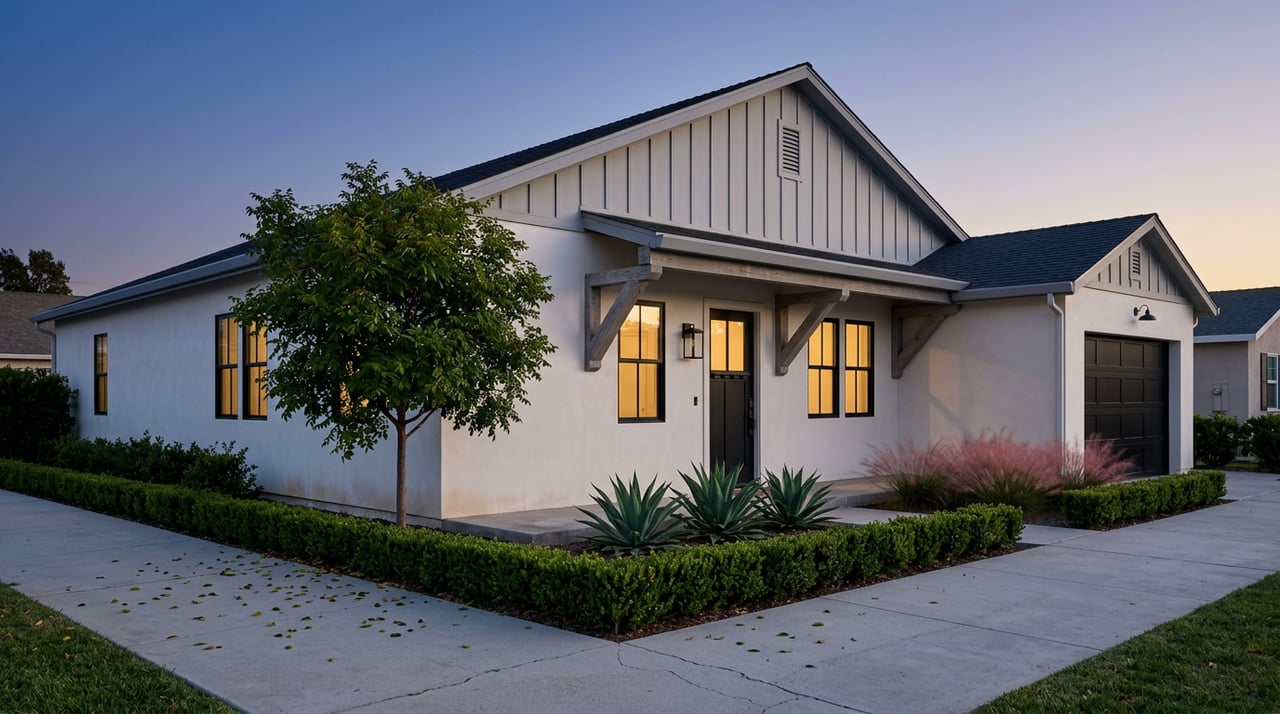
Picture two three-bedroom homes in Dos Vientos, both on quiet hillside streets, both roughly the same square footage, both listed within $50,000 of each other this fall. A buyer comparing them side by side would reasonably assume the carrying costs are close too. They are not. One sits in a tract built when Dos Vientos broke ground in the early 1990s, where the Mello-Roos assessment has nearly paid itself off. The other sits in one of the community's newest sections, still finishing construction in 2026, where that same line item on the tax bill can run several thousand dollars higher every year.
Nothing about the house explains that gap. The gap comes from a date on a bond document, and it is the single most misunderstood cost in Thousand Oaks' largest master-planned neighborhood.
The Bill That Isn't Tied to the House
Dos Vientos is the development that defines the southern half of Newbury Park, roughly 4,000 homes spread across more than 25 tracts on hillside terrain south of the 101. Construction started in 1992 and is still active today, carried out in four distinct phases by a rotating roster of national builders that has included Lennar, KB Home, Pulte, Toll Brothers, and Shea.
Every home in every phase carries a Mello-Roos Community Facilities District assessment. That part is uniform. What is not uniform is the amount, because a CFD assessment isn't a percentage of what your house is worth. It's a fixed installment on a bond that was issued to pay for the roads, sewer lines, and parks a specific tract needed when it was built. The bond has its own repayment schedule, set the year that phase broke ground, and it runs until the debt is retired or a maximum of 40 years passes, whichever comes first.
That is a fundamentally different mechanism than the base property tax most buyers already understand. Under Proposition 13, your base tax is capped at roughly 1% of assessed value and can rise at most about 2% a year. Mello-Roos ignores all of that. It doesn't shrink as a share of value when the market rises, and it doesn't reset when a home resells for more. It just keeps billing according to the schedule the original CFD set, regardless of what the house is worth today.
Four Phases, Four Different Formulas
| Tract era | Built | Typical price range (2026) | Mello-Roos (annual) | HOA (monthly) |
|---|---|---|---|---|
| Phase 1 and 2 | Starting 1992 | Not separately reported | Under $800, near or past payoff | $150 to $250 |
| Phase 3 | 2009 to 2018 | $1.4M to $2.1M | Highest among the older phases, tied to a newer bond | $300 to $400 |
| Phase 4 | 2019 to 2026 | $1.7M to $2.6M, some custom homes above $3.0M | $2,500 to $4,500, with 35 to 40 years remaining | $300 to $400 |
Phase 3 brought Toll Brothers and Shea Homes into the community with 3,800 to 5,500 square foot floor plans on premium hillside and valley-view lots of 7,500 to 10,000 square feet or more. Phase 4, still being completed by Toll Brothers and Lennar, is delivering 4,500 to 6,500 square foot homes on the community's most restrictive architectural terms, the newest energy codes, and the newest bonds.
Stack the low end of Phase 1 against the high end of Phase 4 and the combined recurring cost, Mello-Roos plus HOA, runs from roughly $217 a month to roughly $775 a month. That's a swing of more than $550 a month that has nothing to do with upgrades, lot size, or finish quality. It's entirely a function of which year that particular tract's bond was issued.
What It Actually Costs You at the Kitchen Table
For a buyer, that $550 monthly spread is not academic. Lenders count Mello-Roos in your debt-to-income calculation the same way they count your mortgage payment and HOA dues. A home that looks like a better deal on price per square foot can quietly cost more every month once the CFD line item is added in, and a buyer who compares two Dos Vientos listings purely on list price is comparing the wrong number.
The comparison that actually matters is the parcel-specific tax bill, not a neighborhood average. Two homes can share the Dos Vientos name and sit a few blocks apart while belonging to entirely different CFDs with entirely different remaining terms.
The Comparison Nobody Runs
Buyers set on a master-planned lifestyle in the Conejo Valley sometimes assume the tradeoff is universal: newer infrastructure and amenities in exchange for a CFD assessment. It isn't. Westlake Village's older planned communities, including Westlake, Fairfield, and North Ranch, were built between the 1960s and 1990s and carry no Mello-Roos and no equivalent HOA restrictions, with larger lots and golf course access, though inventory in those tracts turns over slowly and median pricing runs $1.4M to $2.2M, often above comparable Dos Vientos phases simply because of age and established reputation.
Twenty-five minutes north, Big Sky in Simi Valley offers pricing comparable to Dos Vientos Phase 3 and 4 and carries its own Mello-Roos and HOA structure, so the tradeoff there looks similar to what a Phase 4 buyer is already weighing. Moorpark and Camarillo sit at a lower price point, generally $1.0M to $1.4M, but with older infrastructure and longer commutes.
None of these is a better or worse choice in the abstract. The point is that "master-planned community" doesn't automatically mean "Mello-Roos," and knowing which tracts carry it and which don't changes how you should be comparing a Dos Vientos listing against its actual competition.
Before You Write the Offer or Sign the Listing Agreement
For buyers, the fix is straightforward but easy to skip in the rush of an offer deadline. Ask for the seller's actual current-year property tax bill for that parcel, not a neighborhood estimate. The bill will show the specific CFD, the current annual assessment, and often a phone number for the CFD administrator who can confirm how many years remain on the bond and whether the assessment is scheduled to escalate. Run that number, plus HOA dues, as part of your monthly cost comparison before you decide which listing is the better value.
For sellers, particularly those in Phase 1 or Phase 2 tracts where the assessment is near or past payoff, that low or expiring Mello-Roos line is a real, quantifiable advantage over comparable newer-phase inventory, and it belongs in your marketing rather than buried in a disclosure packet a buyer discovers midway through escrow. Pulling the CFD paperwork before you list, rather than after an offer arrives, keeps that advantage from turning into a last-minute negotiating point.
A Few Questions Worth Answering Early
If I successfully appeal my assessed value, will my tax bill drop by a similar amount? Not necessarily. The base tax portion, capped under Proposition 13, will adjust with a successful appeal. Mello-Roos is billed separately as a direct charge tied to your CFD's bond schedule, calculated by square footage, lot size, or a flat per-parcel rate rather than assessed value, so it stays the same regardless of what an appeal does to the rest of your bill.
Is Mello-Roos tax deductible? Generally, no. It is treated differently than the base 1% property tax, and most owners cannot deduct it in the way they deduct standard property tax. A narrow exception can apply if a specific CFD is funding ongoing maintenance or services rather than new infrastructure, but that determination is fact-specific and worth confirming with a tax professional before you assume either way.
Does the citywide median price for Thousand Oaks already account for this? No. A median sale price reflects what buyers paid, not what they're committed to paying annually afterward. Thousand Oaks' overall effective property tax rate runs close to 1.12% across the city on average, a figure that already folds in voter-approved bonds, but a single subdivision's CFD assessment sits on top of that citywide number and varies tract by tract in a way no median can capture.
If you're comparing Dos Vientos listings across phases, or thinking about how to position a Phase 1 or 2 home's paid-down assessment as a selling point, Sean Curts & Associates can pull the actual CFD documentation for a specific parcel before you write an offer or sign a listing agreement.