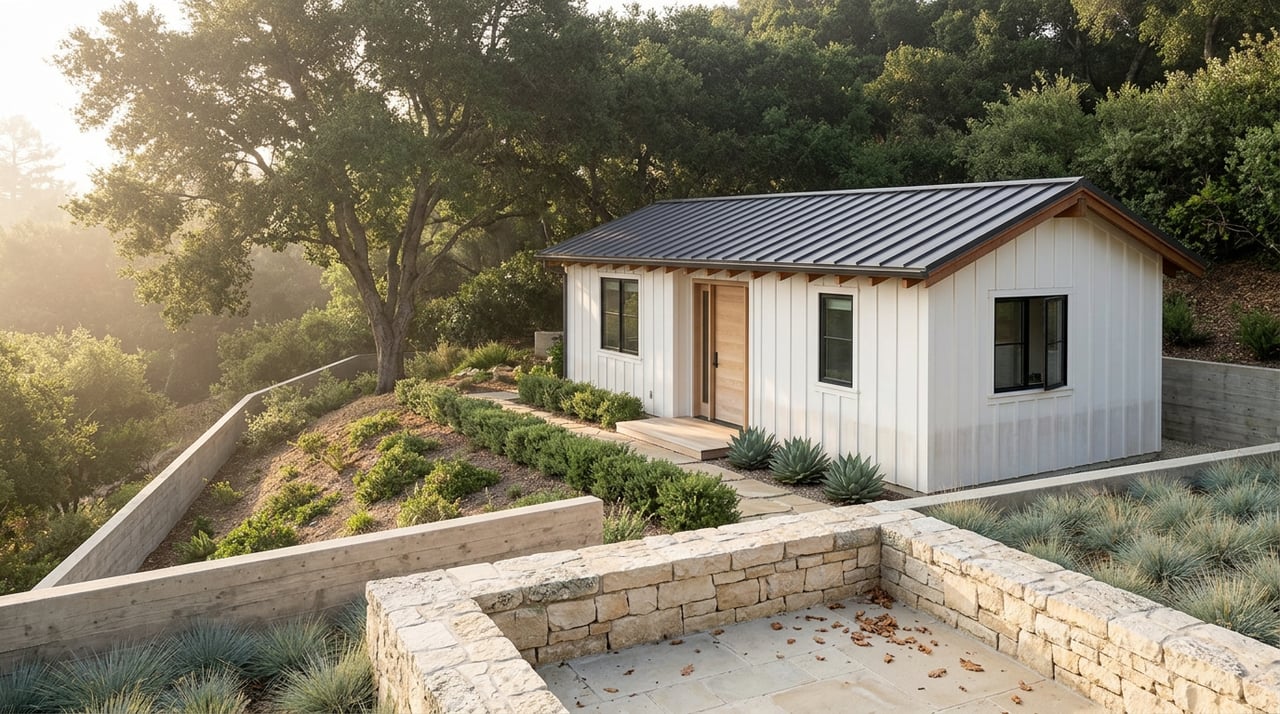
A year ago, adding an accessory dwelling unit in Malibu meant clearing your calendar for a while. A homeowner who wanted a small detached cottage, a garage conversion for aging parents, or a rentable junior unit could expect twelve to eighteen months just to get through the city's own Coastal Development Permit review. If a neighbor or another interested party appealed that approval to the California Coastal Commission, which happened often enough to be part of the planning, add another year on top of that. Two years from application to permit was not the worst case. It was close to the normal case.
That math no longer holds for ADUs. The change did not creep in gradually through better staffing or a friendlier planning department. It arrived by statute, on a specific date, and it is already in force.
On October 10, 2025, AB 462, authored by Assemblymember Lowenthal, was signed into law as an urgency statute, which means it took effect immediately rather than waiting for the following January. The bill eliminated the California Coastal Commission's authority to hear appeals on local Coastal Development Permits for accessory dwelling units anywhere in the Coastal Zone, Malibu included, and it capped the city's own review at sixty days. If you are underwriting a Malibu property with ADU potential this fall, or listing one with a partially built or unpermitted structure, the old timeline you may still be pricing against is no longer the operative one.
The Law That Erased a Year of Uncertainty
Before AB 462, an ADU applicant in Malibu cleared two separate gates. The first was the city's own Coastal Development Permit process under its Local Coastal Program, which historically ran twelve to eighteen months for a straightforward second unit. The second was the appeal window. Because Malibu sits entirely within the Coastal Zone, any approved ADU permit could be appealed to the Commission, and a single appeal routinely added another year while the project sat frozen.
AB 462 closed the second gate outright. Appeals to the Coastal Commission on local ADU permits are no longer permitted under state law. The sixty-day clock that now governs local review applies once an application is deemed complete, and a set of companion bills passed alongside it adds a fifteen-day window for the city to determine completeness in the first place. Stack those two numbers together and a Malibu ADU application that used to disappear into a multi-year queue now has a defined outer edge measured in weeks.
A Second Deadline Landed This Summer
AB 462 handled the appeal problem. A separate bill, SB 1077, authored by Senator Blakespear and codified as Public Resources Code section 30500.5, addressed the part of the process that AB 462 left untouched: the actual local rules Malibu and other coastal cities use to process ADU applications in the first place.
SB 1077 directed the Coastal Commission, working with the state's Department of Housing and Community Development, to publish formal guidance instructing coastal cities how to rewrite their Local Coastal Programs to streamline ADU permitting. That guidance had a hard deadline of July 1, 2026, a deadline that has already come and gone. The draft version went out for public comment on April 13, 2026, with an agency workshop the following month. What that means for a city like Malibu is not that anything changed on July 2 for an individual applicant. It means Malibu now has a state-issued model to work from as it updates its own code over the twelve to twenty-four months that typically follow guidance like this, rather than drafting its ADU ordinance in a vacuum.
The Rewrite Malibu Is Still Finishing
Malibu's own ADU ordinance has been moving in parallel with the state changes, and the version the city is finalizing goes further than simply complying with the new appeal rules. A revised draft was on the Planning Commission's agenda on April 20, 2026, after the City Council had sent an earlier version back for additional work, and it contains several provisions worth knowing if you own, or are evaluating, a Malibu property. You can follow the ordinance's progress directly on the City of Malibu's ADU program page:
- The two permit pathways are relabeled as Class 1, for units regulated directly by state law, and Class 2, for units still subject to local discretion, with explicit sixty-day deemed-approval language written into the Class 2 track.
- The prohibition on attached multifamily ADUs is being removed, and the cap on detached ADUs for multifamily lots is rising from two units to eight.
- Most substantive ADU deed restrictions are being eliminated, leaving only the more limited restrictions state law requires for junior accessory dwelling units.
- The definition of "living area" is being narrowed to exclude garages and accessory structures, which affects how square footage gets counted against a lot's development limits.
- A new Class 2 lot-coverage standard, tiered by parcel size, is replacing older one-size-fits-all coverage rules.
Perhaps the change with the widest reach for existing homeowners is a simpler one: the eligibility cutoff for legalizing an older unpermitted ADU is moving from January 1, 2018 to January 1, 2020. Anyone with a unit built in that two-year window that previously had no path to legalization now has one to consider before deciding whether to disclose it as unpermitted, remove it, or bring it into compliance.
What Sixty Days Actually Buys You
The easiest way to see the shift is side by side.
| Step | Before AB 462 (pre-October 2025) | After AB 462 (current) |
|---|---|---|
| City review of ADU permit | Typically 12 to 18 months | Capped at 60 days once the application is deemed complete |
| Coastal Commission appeal | Available to any interested party, often adding a year | Eliminated by state law for ADUs |
| Realistic worst-case timeline | Two years or more | A few months, barring incomplete applications |
| Unpermitted-unit legalization cutoff | Units built before January 1, 2018 | Units built before January 1, 2020 |
The carrying-cost implications are the part most conversations skip. A holding period that used to run two years on a project meant two years of financing costs, two years of an unusable structure, and two years of uncertainty baked into how a buyer or appraiser treated the ADU line item on a pro forma. A sixty-day local review changes what that same line item is worth today, not hypothetically once the city finishes its paperwork.
Where the Shortcut Stops
None of this touches the main house. AB 462's appeal elimination and sixty-day clock apply specifically to accessory dwelling units. A primary residence, a pool, a significant landscaping change, or any other project that meets the Coastal Act's broad definition of development still goes through the full Coastal Development Permit process, appeal rights included, with the same review timeline that has applied for decades. If your plans mix an ADU with other site work, the ADU portion may move at the new pace while the rest of the project moves at the old one, and it is worth asking early in the process which pathway a given piece of scope falls under.
What This Means If You're Buying, Selling, or Holding
For a seller with an existing unpermitted structure built between 2018 and 2020, the newly extended legalization window is worth pricing into a listing conversation rather than defaulting to disclosure and discount. For a seller further along, with an approved or partially permitted ADU already in progress, the remaining path to completion is now measured in weeks rather than the year or more a buyer might assume based on Malibu's reputation.
For a buyer or investor evaluating a lot with ADU potential, the math on adding rental income space changes because the timeline risk that used to justify a steep discount on projected income has largely come off the table. A junior unit or detached cottage that once represented a two-year bet on permitting now represents a much shorter one, which matters directly to anyone modeling cash flow on a Malibu investment property.
For anyone weighing whether to start an ADU application now or wait for Malibu's ordinance to finish catching up to state law, the honest answer is that the sixty-day clock and the appeal elimination are already the law regardless of where the city's own code text stands. Waiting for the local ordinance to formally reflect SB 1077's guidance is not necessary to benefit from what AB 462 already changed.
A Few Things Worth Confirming Before You Act
Does the sixty-day clock start the day I submit my application? No. It starts once the city deems the application complete, and a related law gives the city fifteen days to make that determination. Build both windows into your timeline rather than counting from your submission date.
If my ADU was already appealed to the Coastal Commission before October 2025, does AB 462 apply retroactively? The law removed the Commission's appeal authority going forward. Anyone with an appeal already pending before the signing date should confirm directly with the city and the Commission how that specific case is being handled, since the research here does not cover retroactive treatment of appeals filed before October 10, 2025.
My unpermitted unit was built in 2016. Does the new cutoff help me? No. The eligibility window moved from January 1, 2018 to January 1, 2020, which helps units built inside that later range. A unit built before 2018 falls outside both the old and new cutoff.
Does any of this apply to a full house rebuild? No. The changes in this piece apply specifically to accessory dwelling units. A primary residence still goes through Malibu's standard Coastal Development Permit process, including the full appeal rights that AB 462 removed only for ADUs.
Malibu's permitting reputation was earned over a long stretch of years, and it is reasonable for a buyer, seller, or investor to still be planning around the old numbers. The current numbers are different, they are already law, and they change what an accessory unit is worth in a deal closing this fall rather than one closing whenever the city finishes updating its code. If you are trying to figure out what a specific Malibu property's ADU potential is actually worth under the current rules, Sean Curts & Associates can walk through the numbers with you and put together a free home valuation that reflects where the market stands today.